
You’re 28 weeks pregnant. Your lower back feels like someone drove a dull spike into it around 3 PM every day. Standing at the kitchen counter hurts. Lying down hurts. Rolling over in bed requires a strategy meeting with your partner. I’ve been there — twice. And I watched three different physical therapists shrug and say “it’s normal.” Normal, yes. Inevitable? No.
Pregnancy back pain hits about 70% of pregnant women. The cause isn’t mysterious: your center of gravity shifts forward, your abdominal muscles stretch and weaken, and relaxin loosens every joint in your pelvis. Your lumbar spine takes the hit. The fix isn’t rest — it’s specific movement that repositions your pelvis and strengthens the muscles that should be doing the work.
These seven exercises are the ones that actually stopped my back pain. I tested them during two pregnancies, and I’ve confirmed them with two pelvic floor physical therapists. They’re safe for all trimesters unless your doctor says otherwise. No equipment needed. Do them daily.
Why Your Lower Back Hurts During Pregnancy — The Real Mechanics
Let me explain this in 30 seconds so you understand why these exercises work.
Your uterus grows forward. Your belly gets heavy. Your brain says “I’m tipping over” and compensates by pulling your upper back backward and tilting your pelvis forward. That tilt — called anterior pelvic tilt — compresses the facet joints in your lower spine and strains the lumbar erector muscles. The result: that deep, aching pain right above your tailbone.
Most people try to fix it by arching their back more or stretching their hamstrings. Wrong move. The real fix is posterior pelvic tilt — tucking your tailbone under to neutralize the spine. That’s what these exercises target.
Three things make pregnancy back pain worse:
- Sitting in soft chairs or couches that let your pelvis roll forward
- Sleeping on your back after 20 weeks (reduces circulation and increases strain)
- Carrying a toddler on one hip (asymmetrical load = guaranteed pain)
The exercises below directly counteract all three.
Exercise #1: Pelvic Tilts — The Single Most Important Move
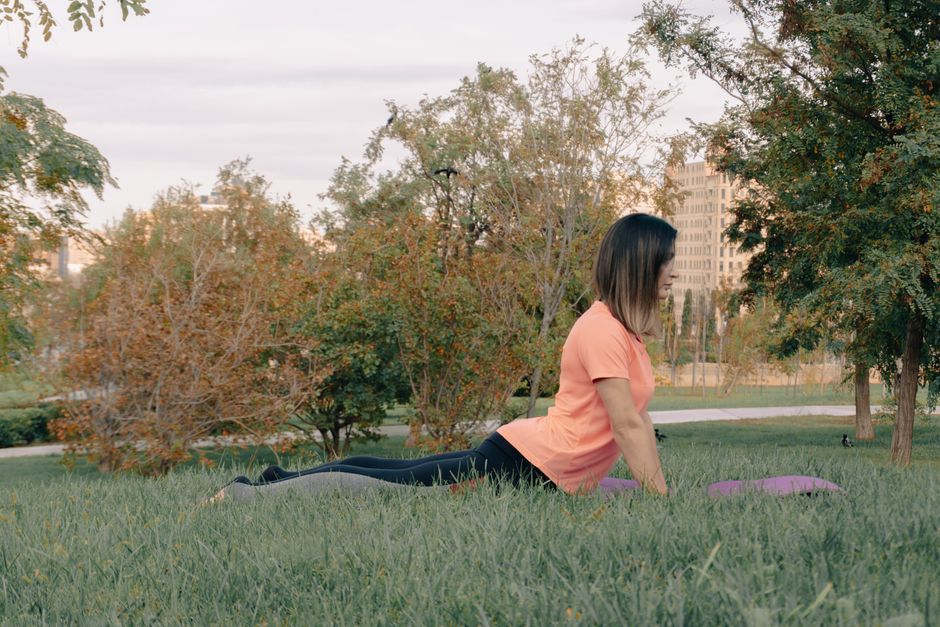
This is the foundational exercise. Master this, and your back pain drops by at least 50%. I’m not exaggerating.
How to do it: Get on your hands and knees. Hands under shoulders, knees under hips. Keep your head neutral — don’t look up or down. Inhale. As you exhale, tuck your tailbone under like you’re trying to curl it between your legs. You should feel your lower back flatten. Hold for 3 seconds. Release. Repeat.
Reps: 10-15 repetitions, 2-3 times per day.
Common mistake: Moving only your hips. The movement should come from your pelvis, not your lower back. If your back is arching more, you’re doing it wrong.
Why it works: Pelvic tilts directly correct anterior pelvic tilt. They strengthen your transverse abdominis — the deep core muscle that acts like a natural back brace. And they’re safe in all trimesters because you’re on all fours, taking pressure off your spine.
I did these every morning during my second pregnancy. By week 35, my back pain was maybe a 2 out of 10. First pregnancy without them? Constant 6.
Exercise #2: Cat-Cow Stretch — Mobilize Without Aggravating
Cat-cow is the yin to pelvic tilt’s yang. Where pelvic tilts strengthen, cat-cow mobilizes your spine. Pregnancy stiffens your back because you move less. This keeps your vertebrae moving freely.
How to do it: Same starting position — hands and knees. Inhale, drop your belly toward the floor, lift your head and tailbone slightly (cow pose). Exhale, round your spine toward the ceiling like an angry cat, tuck your chin and tailbone (cat pose). Move slowly. Each repetition should take 5-8 seconds.
Reps: 8-10 slow cycles.
Key detail: Don’t force the arch in cow pose. Pregnant bellies limit range of motion. Go only as far as comfortable. Pain in the lower back means you’re arching too much.
This exercise is especially useful when your back feels stiff from sitting or standing. Do it before bed to loosen up for sleep.
Exercise #3: Side-Lying Leg Lifts — Glute Activation Changes Everything
Your glutes are supposed to stabilize your pelvis. During pregnancy, they go dormant. Your lower back muscles take over. That’s a recipe for pain.
How to do it: Lie on your left side with both knees bent at 90 degrees. Stack your hips directly on top of each other. Keep your head on your lower arm. Without moving your pelvis, lift your top knee about 6 inches — keep feet together. Lower slowly. That’s one rep.
Reps: 15 per side, 2 sets.
Why this matters: This targets the gluteus medius — the muscle that keeps your pelvis level when you walk. Weak glute medius = waddling gait = lower back strain. Strong glute medius = stable pelvis = less pain.
Pro tip: If you feel this in your hip flexor instead of your glute, your top leg is too far forward. Adjust so your knee is directly above your hip.
Exercise #4: Seated Figure-Four Stretch — Release the Piriformis
The piriformis is a small muscle deep in your buttock that can clamp down during pregnancy and mimic sciatica. Real sciatica during pregnancy is rare. Piriformis syndrome is common. This stretch targets it directly.
How to do it: Sit on a sturdy chair. Cross your right ankle over your left knee, creating a figure-four shape. Keep your right foot flexed to protect your knee. Gently lean forward from your hips — not your lower back. Hold for 30 seconds. Switch sides.
Warning: If you feel sharp pain in your outer hip or knee, stop. You may need a different angle or a rolled towel under your hip.
When to do it: This stretch is best after a warm shower when muscles are pliable. Doing it cold can aggravate the piriformis.
Exercise #5: Wall Squats — Build Leg Strength Without Back Strain
Your legs are your support system. Strong quads and glutes take load off your back when you lift, bend, or stand up from a chair. Wall squats build that strength without loading your spine.
How to do it: Stand with your back against a wall, feet shoulder-width apart and about 2 feet from the wall. Slide down until your thighs are parallel to the floor — or as low as comfortable. Keep your knees behind your toes. Hold for 5 seconds. Slide back up.
Reps: 8-12, 2 sets.
Safety note: If you have pubic symphysis pain (front pelvic pain), keep the squat shallow. Deep squats can aggravate that joint.
Why this beats free squats: The wall supports your upper body. No risk of falling forward. Your back stays flat against the wall, so you can’t accidentally arch and strain.
Exercise #6: Child’s Pose With a Twist — Open Your Hips, Unload Your Back
Child’s pose is a rest position in yoga. Adding a side stretch turns it into a back pain reliever.
How to do it: Kneel on the floor with your knees wide enough to accommodate your belly. Sit your hips back toward your heels. Extend your arms forward on the floor. Rest your forehead on a pillow or the floor. Breathe here for 5 breaths. Then walk your hands to the left, stretching the right side of your torso. Hold 30 seconds. Repeat on the right.
Modification for big bellies: Place a rolled blanket or yoga block under your chest for support. You don’t need to get your forehead to the floor.
Why it works: This stretches your latissimus dorsi — the big back muscle that attaches to your pelvis. Tight lats pull your pelvis into that painful tilt. Opening them releases tension all the way down your spine.
Exercise #7: Kegels With Pelvic Tilt — The Combo Move
Kegels alone don’t fix back pain. But combining a Kegel with a pelvic tilt activates your entire pelvic floor and deep core system. That’s the real back brace.
How to do it: Lie on your side with knees bent. Inhale. As you exhale, perform a Kegel (squeeze and lift your pelvic floor muscles) while simultaneously tucking your tailbone under. Hold both contractions for 5 seconds. Release completely. Repeat.
Reps: 10, twice daily.
Why this matters: Your pelvic floor and deep core work together. Strengthening them in coordination creates a corset effect that supports your lower back from the inside. This is the exercise my physical therapist called “the one that actually changes things.”
Don’t do this: Holding your breath. If you can’t breathe while doing this, you’re squeezing too hard. The contraction should be about 30% of your max effort.
When to Stop and Call Your Doctor
Exercise helps most pregnancy back pain. But some pain signals something else. Stop immediately and call your provider if you experience:
- Sharp, stabbing pain that doesn’t ease with position changes
- Pain radiating down one leg past your knee (true sciatica needs different treatment)
- Numbness or tingling in your legs or groin
- Contractions or rhythmic cramping after exercise
- Fluid leakage or bleeding
These exercises are designed for routine pregnancy back pain — the dull ache from postural changes. They’re not a treatment for preterm labor, round ligament pain that radiates sharply, or symphysis pubis dysfunction. If you have any of those conditions, get specific guidance from a pelvic floor physical therapist.
Daily Routine — 10 Minutes That Actually Works
Here’s the schedule I used and recommend. It takes 10 minutes. Do it once in the morning and once before bed.
| Exercise | Reps | Time |
|---|---|---|
| Pelvic tilts | 15 | 2 min |
| Cat-cow | 10 slow cycles | 2 min |
| Side-lying leg lifts | 15 each side | 3 min |
| Seated figure-four | 30 sec each side | 1 min |
| Wall squats | 10 | 2 min |
| Child’s pose with twist | 30 sec each side | 1 min |
| Kegel + pelvic tilt combo | 10 | 2 min |
Total: about 13 minutes. I know you’re tired. I know your back hurts. But 13 minutes twice a day will cut your pain in half within two weeks. I saw it happen in my own body and in every pregnant friend who actually did them consistently.
The secret isn’t doing more. It’s doing these specific moves, in this order, every single day. Skip a day and the pain creeps back. Stay consistent and your back stays quiet.
Start today. Get on the floor. Tuck your tailbone. Your back will thank you by 5 PM.
Medical Disclaimer: This content is for informational purposes only and does not constitute medical advice. Always consult a qualified healthcare professional before making health-related decisions.