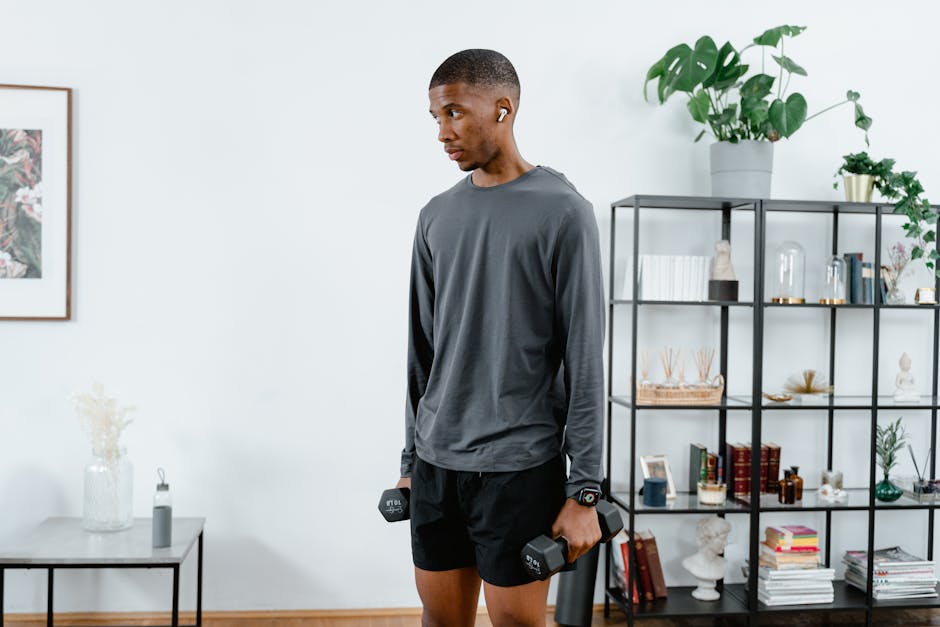
Can you lose belly fat working out in your living room? Yes — but not the way most fitness content suggests. The problem isn’t motivation or missing equipment. It’s that most people spend months doing the wrong exercises at the wrong intensity, then quit when nothing changes.
This guide covers the physiology behind belly fat loss, which exercise types produce results faster, a concrete 4-week schedule, and the tools worth spending money on.
Why Most Ab Exercises Won’t Shrink Your Waist
Here’s the uncomfortable reality: crunches, sit-ups, and leg raises build the muscles underneath belly fat. They don’t remove the fat sitting on top.
Belly fat comes in two distinct forms. Subcutaneous fat sits just under the skin — soft, pinchable, and responsive to exercise and diet changes over time. Visceral fat wraps around your internal organs deeper in the abdominal cavity. Visceral fat is metabolically active and linked to insulin resistance, chronic inflammation, and elevated cardiovascular risk. It’s also, somewhat counterintuitively, easier to lose through sustained exercise than subcutaneous fat is.
Spot reduction — the belief that training a specific muscle burns fat from that region — has been disproven clearly. A 2013 study published in the Journal of Strength and Conditioning Research had participants perform seven weeks of targeted abdominal exercises with no changes to diet or broader training volume. The result: no measurable reduction in abdominal fat. The muscles got stronger. The fat stayed.
What Your Body Actually Burns During Exercise
Fat loss comes down to energy balance. When your body burns more calories than it takes in, it pulls from stored fat — drawn from across the entire body, not just the area being trained. The abdomen tends to shed fat later than the face, arms, and legs because fat distribution follows genetic patterns you can’t override through exercise selection.
This doesn’t make belly fat impossible to lose. It means the path there runs through total-body calorie expenditure and a sustained caloric deficit, not isolated ab work. The most efficient exercises for this are compound movements — burpees, jump squats, mountain climbers, push-up variations — that recruit multiple large muscle groups at once, burning significantly more calories per minute than any crunch variation ever will.
The Role of Cortisol in Abdominal Fat Storage
Chronic stress elevates cortisol, which signals the body to preferentially store fat around the abdomen. Sleep deprivation, overtraining without adequate recovery, and sustained high-stress lifestyles all tend to show up first at the waist — not just as a matter of diet.
This is why recovery days aren’t optional extras. Two or three hard HIIT sessions per week produce fat loss. Six consecutive high-intensity sessions without rest can actually raise cortisol levels and work against you. Train hard, recover fully, sleep 7–8 hours, and stop expecting crunches alone to produce anything visible on the waistline.
HIIT vs Strength Training vs Steady Cardio: A Direct Comparison

All three approaches produce fat loss. They work on different timelines, suit different fitness levels, and carry different tradeoffs. Here’s the breakdown.
| Method | Weekly Time | Calories Per Session | Best For | Main Downside |
|---|---|---|---|---|
| HIIT (intervals) | 3 sessions × 20–30 min | 300–450 kcal | Time-limited schedules, fast metabolic boost | Injury risk if form breaks; needs 48h recovery between sessions |
| Bodyweight Strength | 3–4 sessions × 35–45 min | 200–350 kcal (plus 24–48h elevated resting burn) | Long-term fat loss, visible muscle definition | Slower visible results in weeks 1–3 |
| Steady-State Cardio | 4–5 sessions × 30–60 min | 250–500 kcal depending on pace | Beginners, low-impact needs, stress management | Time-intensive; body adapts and efficiency drops after 4–6 weeks |
| HIIT + Strength Combined | 4 sessions × 30–40 min | 350–500 kcal plus afterburn | Fastest body composition changes overall | Requires careful scheduling to avoid overtraining |
The Clear Verdict for Home Training
For belly fat reduction without gym access, HIIT combined with bodyweight strength work is the most efficient approach. Three sessions per week at 25–30 minutes each, paired with two active recovery days, produces measurable waist reduction in 6–8 weeks when nutrition is consistent.
If you’re entirely new to exercise or returning after a long break, spend the first two weeks doing 30-minute steady-state cardio sessions only — brisk walking, jogging in place, or cycling. This builds the cardiovascular base before adding HIIT-level intensity, which reduces injury risk and makes the transition more sustainable.
Why the Afterburn Effect Changes the Calorie Math
HIIT and strength training both trigger Excess Post-Exercise Oxygen Consumption — EPOC — where your body continues burning calories at an elevated rate for 12–24 hours after the session ends. Steady cardio produces minimal EPOC. That’s why a 25-minute HIIT circuit often outperforms a 50-minute jog in total caloric impact measured across the following day. For people short on time, this is the most important number in the comparison table above.
A 4-Week Home Workout Schedule That Targets Belly Fat
No equipment required for weeks one and two. Each session runs 25–35 minutes. The structure alternates intensity deliberately to allow muscular recovery while maintaining training frequency — the key variable in fat loss programs.
- Monday — HIIT Circuit (28 minutes): 40 seconds of work, 20 seconds of rest, 4 rounds. Exercises per round: burpees, jump squats, mountain climbers, high knees, push-ups. Take a 90-second full rest between rounds.
- Tuesday — Active Recovery (20–25 minutes): Walk at a pace where you can hold a conversation easily. Light stretching or a beginner yoga flow. Heart rate should stay below 120 bpm. This isn’t optional — it accelerates recovery without adding cortisol stress.
- Wednesday — Bodyweight Strength (35 minutes): 3 sets of 12–15 reps each. Exercises: goblet squats (bodyweight), reverse lunges, push-up variations, glute bridges, 45-second plank holds, dead bugs. Rest 60 seconds between sets.
- Thursday — Rest. Full rest or a short walk. No training.
- Friday — HIIT Circuit (28 minutes): Same format as Monday. Swap exercises if Monday felt manageable: tuck jumps, skater hops, squat thrusts, lateral shuffles, speed skaters.
- Saturday — Core-Integrated Strength (30 minutes): 4 exercises, 3 rounds each. Bicycle crunches paired immediately with jump squats (so the heart rate stays elevated), hollow body holds, Russian twists, push-up to downward dog. The goal here is combining core work with enough total-body effort to keep calorie burn meaningful.
- Sunday — Full rest.
In weeks 3 and 4, increase HIIT work intervals to 45 seconds on and 15 seconds rest, add a fifth round, and bump strength reps by 3–5 per set. Progressive overload — even in purely bodyweight training — is what forces continued adaptation. Without it, your body stops changing after week two.
What to Eat Around These Sessions
Eat a small protein-carb meal 60–90 minutes before HIIT days: Greek yogurt with banana, two eggs on toast, or oats with a scoop of protein powder. After strength sessions, hit 20–40g of protein within 30–60 minutes — a chicken wrap, cottage cheese, or a standard whey shake all work. Skipping post-workout protein slows muscle repair, which slows resting metabolic rate, which slows fat loss. The compounding effect is real and it compounds in the wrong direction fast.
Four Mistakes That Kill Results Before Week Two

Most people abandon home workout programs because they see no results in the first 10 days. These are the four reasons that actually happens.
Are you treating crunches as your main exercise?
A 150-pound person burns roughly 50 calories in 10 minutes of crunches. That same person burns 200+ calories in 10 minutes of high-effort burpees. Core isolation exercises have a role in overall fitness — but as the centerpiece of a belly fat program, they’re the wrong tool entirely. Replace half your core-only work with compound movements and you’ll see faster results without adding a single extra minute to your routine.
Is your intensity actually high enough to matter?
The most common self-deception in home workouts is calling a comfortable session a workout. Genuine HIIT should feel hard during the work intervals — you should not be able to hold a full conversation. Heart rate above 75–85% of your maximum (roughly 220 minus your age) is the target zone. If you’re comfortable throughout, you’re not creating the metabolic demand that drives fat loss. A basic fitness tracker like the Fitbit Charge 6 ($159) or even a free heart rate app will confirm actually hitting the required intensity.
Are you compensating with food without realizing it?
Research consistently shows people underestimate calorie intake by 20–40%. A 30-minute HIIT session burns around 280–350 calories. One extra handful of mixed nuts or a medium oat milk latte adds that right back. No calorie counting system is perfect, but tracking intake for even two weeks using Cronometer (free) or Lose It! ($39.99/year) reveals patterns most people genuinely don’t see otherwise. The data is usually surprising.
Are you sleeping less than 7 hours consistently?
Sleep deprivation elevates ghrelin — the hunger hormone — and suppresses leptin, which signals satiety. Studies show people consume 300–400 more calories per day when sleeping under six hours. Chronic poor sleep also raises cortisol directly, which promotes visceral fat storage independent of how many calories you eat. No exercise routine fully compensates for sustained sleep debt. If you’re training consistently and seeing no progress, sleep is the first variable to audit.
The Only Home Equipment Worth Buying for This Goal
Buy a jump rope before you buy anything else. The CrossRope Get Lean Set ($108) comes with a 1/4 lb and a 1/2 lb weighted rope, plus app integration with guided jump workouts. Ten minutes of moderate jump rope burns 100–130 calories and requires about four square feet of space. Nothing else delivers that caloric output per dollar at home.
After that, add resistance bands: the Fit Simplify Resistance Loop Bands ($14.95 for five resistance levels on Amazon) add meaningful challenge to squats, glute bridges, and lateral movements without taking up drawer space. For longer loop bands that enable assisted pull-ups and more varied strength work, the Serious Steel 41-inch bands run $18–$45 depending on resistance level.
A quality mat matters more than most people expect. The Manduka PRO ($120, 6mm thick) or the Liforme Original ($140, 4.2mm with alignment markers) both provide enough cushioning to protect your knees and hips during floor work without sliding. Cheap mats bunch and slip — they become an annoyance that makes you skip sessions.
Skip the under-desk ellipticals, the ab rollers sold by influencers, and the vibrating massage belts. None of them produce measurable fat loss. Compound bodyweight movements, a jump rope, and a resistance band set outperform all of them for this specific goal.
Fitness Apps That Make the Difference Between Consistency and Quitting
The Nike Training Club app is free, contains over 200 guided workouts including dedicated fat-burning circuits requiring zero equipment, and the programming is genuinely well-designed. The coaching cues are clear, rest timers are built in, and it tracks weekly progress. For most people starting a home routine, it’s the only app needed — and the price is right.
For structured HIIT with a community element, FitOn (free with optional $79.99/year premium) offers live and on-demand classes from certified trainers. The free tier is sufficient for beginners. For more advanced periodized plans — 8–12 week programs that adjust intensity as your fitness improves — the Peloton app at $12.99/month gives full access to their entire class library without requiring any Peloton hardware. It’s one of the better values in structured home fitness right now.
One honest observation: the best app is the one you’ll actually open six weeks from now. If you’ve downloaded and abandoned five fitness apps already, the problem isn’t the software. Build the habit first — using nothing but a phone timer and the schedule above — before adding tracking complexity on top of it. Habit precedes optimization.
Home workouts for belly fat are a longer game than most people expect going in. The first two weeks feel slow because they are slow — the body is adapting before it starts visibly changing. Weeks four through eight are where body composition actually shifts, provided training stayed consistent and intensity stayed honest. The biology works. The only remaining variable is whether you show up three times a week and don’t manufacture reasons to stop when the scale doesn’t move on day five.
Medical Disclaimer: This content is for informational purposes only and does not constitute medical advice. Always consult a qualified healthcare professional before making health-related decisions.