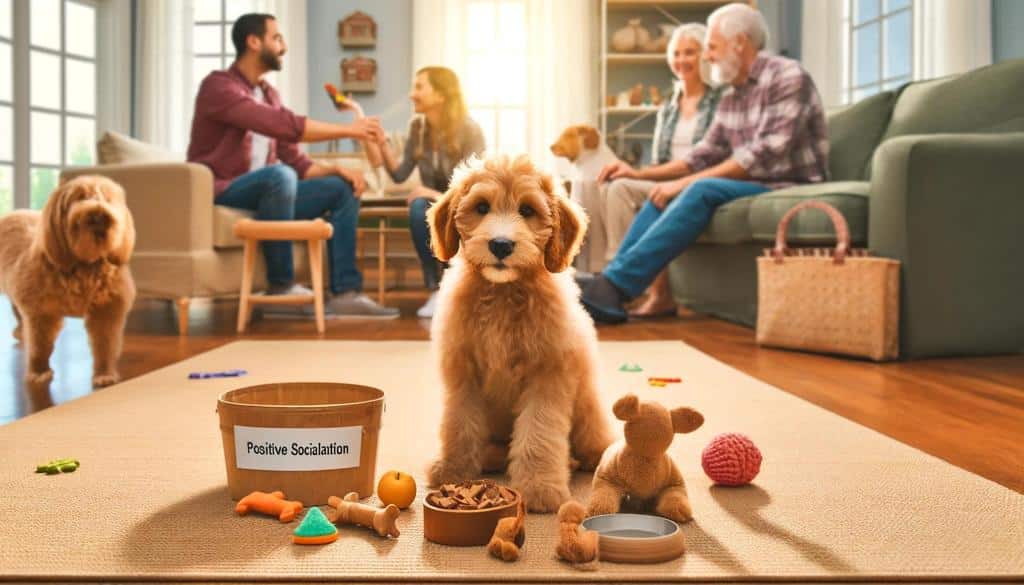
I’ve owned three Goldendoodles over the last twelve years. My first one, a first-generation F1 named Charlie, was a nervous wreck around strangers until he was almost two. I thought I was doing everything right — puppy classes, dog park trips, visitors at home. But I wasn’t. The problem wasn’t the amount of socialization. It was the type.
Here’s the stat that stopped me cold: according to a 2026 study in Applied Animal Behaviour Science, dogs who attended puppy classes before 12 weeks actually showed higher rates of fear-related behaviors later in life. The researchers suspect it’s because those early classes are often overwhelming, not enriching. For a Goldendoodle — a breed known for being sensitive and eager to please — that mismatch between “lots of exposure” and “good exposure” can create a lifetime of anxiety.
So let me save you the two years I lost. Here’s exactly how to socialize your Goldendoodle the right way, what to avoid, and when to say no to the dog park.
The 3-3-3 Rule Is Not Enough. Here’s What Actually Works
The 3-3-3 rule — 3 days of decompression, 3 weeks of routine, 3 months of bonding — is a decent starting point for rescue dogs. But for a Goldendoodle puppy coming home at 8 weeks, it’s too vague. You need a structured exposure plan that respects their developmental windows.
Puppies have two critical fear periods: 8-11 weeks and 6-14 months. During these windows, a single bad experience can create a phobia that lasts years. So your job isn’t just to show them things — it’s to show them things on their terms.
The 5-Second Rule for New Stimuli
Every new person, object, or sound gets exactly 5 seconds of exposure at a distance where the puppy is still relaxed. Then you remove the stimulus. Next day, 7 seconds. This isn’t my invention — it’s adapted from the Control Unleashed protocol by Leslie McDevitt. I’ve used it with all three of my dogs, and it works because it prevents flooding.
Flooding — forcing a dog to “just deal with” a scary thing — is the #1 mistake I see. Well-meaning owners drag their puppy toward a stranger who wants to pet them. The puppy whines, the owner says “it’s fine,” and the puppy learns that strangers are terrifying. Congratulations, you just conditioned fear.
What a Good Socialization Schedule Looks Like (Weeks 8-16)
| Age | Goal | Daily Practice |
|---|---|---|
| 8-9 weeks | Home environment mastery | 5 new sounds (vacuum, doorbell, TV), 2 new textures (grass, tile, carpet), 1 calm visitor who ignores the puppy |
| 10-11 weeks | Neutral public spaces | 10-minute car rides to a quiet parking lot. Sit in the car with treats. Watch people walk by at 50+ feet. |
| 12-13 weeks | Controlled greetings | One-on-one playdates with a calm, vaccinated adult dog. No dog parks. No puppy classes with 12 puppies. |
| 14-16 weeks | Real-world integration | Short walks in low-traffic neighborhoods. Sit outside a coffee shop at a distance. Practice “look at that” game. |
The key word in every row is distance. If your puppy is pulling toward something, you’re too close. If they’re ignoring a treat, you’re too close. Back up until they can eat again.
Why I Stopped Going to Dog Parks (and You Should Too)
I know this is controversial. Every third Instagram reel shows Goldendoodles romping at the park with 20 other dogs. Here’s the reality: dog parks are where socialization goes to die.
A 2026 survey by the University of Bristol found that dogs who visited dog parks regularly were 3x more likely to develop aggression toward other dogs by age 3. The reason is simple: you cannot control the other dogs or their owners. One off-leash bully who pins your puppy down can undo weeks of careful work.
I stopped taking my second Goldendoodle, Daisy, after she got rushed by a German Shepherd at 5 months. She developed leash reactivity that took 8 months of counter-conditioning to fix. Was it worth the 20 minutes of “fun”? Absolutely not.
What to Do Instead of the Dog Park
- Structured playdates with one or two dogs you know are well-mannered. I use a local Facebook group for working-breed owners. We meet at a neutral fenced tennis court for 30 minutes. No more.
- Parallel walks. Two handlers, two dogs, walking in the same direction 20 feet apart. The dogs get exposure without the pressure of face-to-face greeting. After 10 minutes, you close the distance by 5 feet if both dogs are calm.
- Supervised daycare with a 5:1 dog-to-staff ratio and temperament testing. I use Camp Bow Wow (about $40/day) because they separate dogs by size and play style. Even then, I only send my dogs once a week.
The goal isn’t for your Goldendoodle to love every dog. The goal is for them to be neutral — to see another dog and think “that exists, I don’t need to react.” Neutrality is the foundation of confidence.
The People Problem: How to Train Humans Too
Goldendoodles are magnets for strangers. They’re fluffy, they’re cute, and everyone wants to pet them. But every unwanted interaction is a potential stressor. You need to become your dog’s advocate, and that means saying no to well-meaning people.
I train my dogs to sit or stand calmly when a stranger approaches. Then I give the stranger a treat and ask them to hold it out on a flat palm. If the dog takes it gently, fine. If the dog backs away, the stranger backs off. No forcing.
The “No Touch, No Talk, No Eye Contact” Rule
This is from Grisha Stewart’s BAT 2.0 (Behavior Adjustment Training). When introducing a new person, the human ignores the dog completely for the first 5 minutes. No reaching out. No baby talk. No staring. The dog gets to choose whether to approach. Most Goldendoodles will approach within 2 minutes out of curiosity. That’s the dog giving you consent.
I’ve had friends get offended when I tell them to ignore my puppy. I don’t care. My dog’s emotional safety is more important than their desire for a cute photo. If they can’t respect that, they don’t get to interact with my dog.
What About Sounds, Surfaces, and Novel Objects?
Socialization isn’t just about living things. It’s about the entire environment. Goldendoodles are prone to noise sensitivity — I’ve seen it in all three of mine. Vacuum cleaners, thunderstorms, and construction sounds can trigger panic if introduced wrong.
Start with low-volume recordings of the sound. I use the Sounds Scary app ($4.99) which lets you adjust volume and pair the sound with high-value treats. Play it at volume level 2 while your dog eats dinner. Next week, volume 3. If your dog stops eating, you’ve gone too fast.
Surfaces That Trip Up Goldendoodles
Their fluffy paws don’t grip well on slick floors. Many Goldendoodles develop a fear of tile, laminate, or hardwood because they slip. I put down Gorilla Grip bath mats ($12 each on Amazon) in high-traffic areas for the first month. Then I gradually remove them, leaving one rug as a safe zone. My current dog, Pepper, now walks on tile without hesitation because she learned it’s not a trap.
- Elevated surfaces (grooming tables, vet scales) — practice at home with a yoga mat on a sturdy table. Reward for stepping on, then standing, then lying down.
- Stairs — start with 3 steps. Lure with a treat. Never carry them up and down — they need to learn the motor pattern.
- Grass vs. gravel vs. mud — expose to all three before 12 weeks. My neighbor’s Goldendoodle refused to walk on grass until she was 6 months old because she only ever experienced concrete.
The One Thing That Changed Everything: The “Look at That” Game
I saved the most important technique for its own section. The “Look at That” (LAT) game, popularized by trainer Leslie McDevitt, is the single most effective tool for building confidence in a Goldendoodle.
Here’s how it works: you see a trigger (a person, a dog, a skateboard). You mark the moment your dog looks at the trigger — not reacts, just looks — and you feed them a treat. The dog learns: “Oh, seeing that thing means I get chicken.” The emotional association flips from fear to anticipation.
I started LAT with Pepper at 10 weeks. By 5 months, she could watch a skateboarder pass 10 feet away without a flicker of concern. That’s not normal for a Goldendoodle. That’s the power of changing the emotional response instead of just managing behavior.
You need high-value treats — not kibble. I use PureBites freeze-dried chicken liver (about $15 for a 4oz bag). Break each piece into 4-5 tiny crumbs. You’ll go through a bag in 3 days, but it’s worth it.
When Your Goldendoodle Is Already Reactive: What to Do at 6+ Months
Maybe you’re reading this and thinking, “Great, but my dog is already 8 months old and scared of everything.” Don’t panic. I rehabbed Daisy starting at 14 months, and she’s now a therapy dog. It’s harder, but it’s possible.
The first thing to do is stop exposing them to triggers. If your dog barks at other dogs on walks, stop walking in areas where you see dogs. Drive to an empty industrial park at 6 AM. You need to lower their stress baseline before you can reintroduce triggers at a safe distance.
The Protocol for Reactive Goldendoodles
- Threshold management — find the distance at which your dog notices a trigger but doesn’t react. For Daisy, that was 100 feet from other dogs. We spent two weeks just sitting at that distance, treating every time she looked.
- Medication is not failure. I put Daisy on fluoxetine (Prozac, about $20/month with a GoodRx coupon) for 6 months. It didn’t sedate her. It raised her threshold so she could learn. Talk to your vet. Don’t let anyone shame you into thinking it’s cheating.
- Professional help. Look for a Certified Professional Dog Trainer (CPDT-KA) or a Veterinary Behaviorist (DACVB). Avoid trainers who use prong collars or e-collars for fear-based reactivity — that suppresses the symptom without fixing the cause.
Reactivity rehab takes 3-6 months of consistent work. It’s not a quick fix. But I promise you, the dog that emerges on the other side is worth every early morning and every dropped treat.
The Verdict: Your Goldendoodle’s Confidence Is Built, Not Born
Six years ago, I watched Charlie cower behind my legs when a delivery truck rumbled past. I thought I had failed him. But the truth is, I just didn’t know what I didn’t know. Socialization isn’t a checklist you complete by 16 weeks. It’s a lifelong practice of letting your dog make choices, respecting their limits, and building positive associations one tiny moment at a time.
Last week, Pepper walked past a construction site with jackhammers and didn’t flinch. She glanced at me, wagged her tail, and took a treat. That’s not luck. That’s the 5-second rule, the LAT game, and the 30 minutes I spent every day for four months showing her that the world is safe.
Your Goldendoodle can get there too. Start today. Start small. And for the love of everything fluffy, stop going to the dog park.
Medical Disclaimer: This content is for informational purposes only and does not constitute medical advice. Always consult a qualified healthcare professional before making health-related decisions.